Making Tax Digital: April 2026 is Here - What Happens NOW?
The White Rabbit wasn’t joking. April 2026 has arrived, and Making Tax Digital for Income Tax is no longer something to quietly research — it’s something to actually do. If you’ve read our earlier guide, welcome back; if you’ve arrived in a mild panic clutching a calculator, you’re in precisely the right place. Let’s look at what this means right now — this week, this month — and how to step confidently onto the correct side of HMRC’s newly digital realm.
Alice in Numberland
2/19/20265 min read


Making Tax Digital: April 2026 Is Here — What Happens NOW?
Written by Alice in Numberland
Well, the White Rabbit wasn't joking. April 2026 has arrived, and for thousands of sole traders across the UK, Making Tax Digital for Income Tax (MTD ITSA) is no longer something to read about — it's something to actually do. If you read our previous post about when you'd need to join, welcome back. If you're here for the first time in a panic, you're in exactly the right place.
Let's talk about what happens right now — this week, this month — and how to make sure you're on the right side of HMRC's brand new digital world.
A Quick Recap: Who's In?
If your gross income from self-employment or property was over £50,000 in the 2024/25 tax year, you are mandated to use MTD ITSA from 6 April 2026. Remember — that's gross income, your total turnover before any expenses come off. A builder with £68,000 of invoices and £22,000 of materials costs still has £68,000 of qualifying income, even though his profit is only £46,000.
Not sure if you're in? Here's the quick test: dig out your 2024/25 Self Assessment. Find your gross trading income (not profit — income). Add any property rental income on top. If the total is over £50,000, the clock started on 6 April 2026.
Meet Our Clients — Where Are They Now?
Bits & Bobs (gift shop, £55,000 gross in 2024/25) and Brick Buddy Ltd (building services, £52,000 gross in 2024/25): Both over £50k — they're in Wave 1. MTD started for them on 6 April 2026.
J. Digs & Daughter (estimated £45,000 gross in 2025/26) and Handy Andy (estimated £32,000 gross in 2025/26): Both comfortably in Wave 2 — April 2027. But the smart move is to start preparing NOW.
If you're more like Bits & Bobs or Brick Buddy — the clock is already running. If you're more like J. Digs or Handy Andy — use this as your advance warning.
So What Does 'It Started' Actually Mean?
Here's the bit that catches people out: MTD ITSA didn't send anyone a starting pistol. There was no automatic enrolment. You have to sign up — and if you haven't done that yet, that's step one, today.
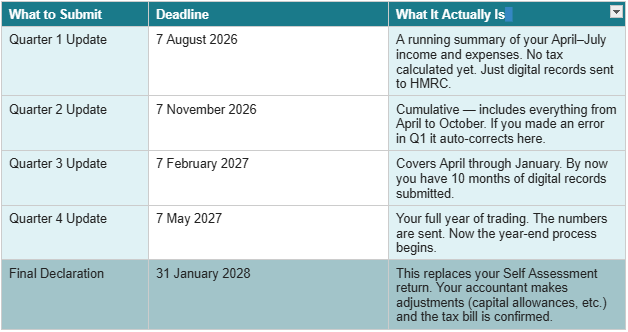
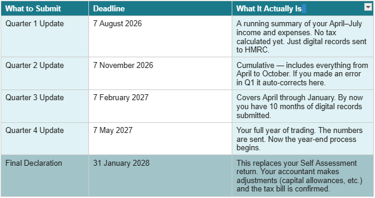
Once you're signed up, here's what your new year looks like. Instead of one annual tax return in January, you now have four quarterly updates plus a final declaration at the end. Think of it like submitting a brief progress report to HMRC four times a year, then wrapping everything up neatly in January.
The Grace Period — What It Means (And What It Doesn't)
HMRC has confirmed that in 2026/27 — the first year — there will be no penalty points issued for late quarterly updates. Breathe. But please don't read that as 'I can ignore the deadlines.' Here's the critical nuance:
No penalty POINTS for missing a quarterly deadline in 2026/27.
Late PAYMENT penalties still apply if you pay your tax late.
The Final Declaration on 31 January 2028 has NO grace period — miss that and the penalties kick in immediately.
From April 2027 onwards, the full penalty points system is live. Miss 4 quarterly deadlines = £200 fine, then £200 per further miss.
The grace period is a practice run, not a free pass. Use it to build good habits — because year two has no safety net.
What HMRC Actually Needs You to Record
This is where the Wonderland rabbit hole gets a little technical, so let's keep it simple. HMRC needs three things recorded for every transaction: the date, the amount, and the category. Not a monthly total — individual records, each with its own date.
The one exception: if you're a retailer (shop, café, market stall), you can record gross daily takings as one figure per day rather than logging every single sale. But it must be daily, and it must be done digitally.
What Doesn't Count as Digital Record-Keeping
Writing income in a notebook and typing the total into software at month end — not compliant.
Keeping a spreadsheet and copy-pasting the totals into HMRC's system — not a digital link.
Bank statements as your only record — not sufficient on their own.
Shoebox of receipts photographed in January — not compliant (though the photos are a good start!).
The Software Question
You need HMRC-approved MTD-compatible software. The good news: most of the major bookkeeping apps are ready — Xero, QuickBooks, FreeAgent (still free with a Mettle or NatWest business account), and others. HMRC maintains an official list on GOV.UK.
The software connects directly to HMRC via an API — meaning your quarterly updates are sent automatically from within the app, with no manual copying or pasting. Once it's set up, submitting a quarterly update can be a matter of a few clicks. Getting it set up correctly in the first place is where people need help.
What About Your Accountant?
Here's something important to understand: the quarterly updates are not tax returns. No tax is calculated, no adjustments are made. The quarterly updates are just your running record of income and expenses, submitted digitally.
The Final Declaration at year-end is where your accountant earns their fee — making adjustments for capital allowances, private use of assets, and anything else that affects your actual tax bill. If your books are clean and your quarterly updates are accurate, their job is significantly faster. Which means their bill to you should be lower.
Think of the quarterly updates as doing the preparation work that makes January much less painful for everyone.
What Should You Do This Week?
Check your 2024/25 gross income. Are you over £50,000? If yes — you needed to sign up before April 2026. Do it now if you haven't.
Choose your software if you haven't already. FreeAgent, Xero and QuickBooks are all solid choices.
Connect your bank feed so transactions start flowing in automatically.
Make sure transactions since 6 April 2026 are being recorded digitally.
Your first quarterly update is due 7 August 2026 — you have time, but not infinite time.
Lost? That's What We're Here For.
At Alice in Numberland, we've been guiding sole traders through exactly this transition. Whether you need software set up from scratch, a monthly records review, or someone to take the whole thing off your plate — we're your White Rabbit.
We've also put together a free MTD Readiness Checklist for Wave 1 businesses — download it below, work through it, and if there are ticks you can't tick on your own, you know where to find us.
Not in Wave 1? Don't Switch Off Just Yet.
If your gross income is between £30,000 and £49,999 in 2025/26, you'll join MTD in April 2027.
That sounds far away. It isn't. We've created a 'Year Ahead' MTD Calendar for Wave 2 businesses — so you know exactly what's coming and when.
Download it free and use it to get ahead of the curve.
Alice in Numberland — making numbers make sense, one curious business at a time.
Alice in Numberland
Professional bookkeeping solutions for your business needs.
Contact:
Tel UK (or text):
01287 750999
© 2025. All rights reserved.