The Case of The Dormant Company
When a soap maker’s official records say "dormant" but her shop is bubbling with thousands of sales, a trip down the rabbit hole is required. Join me as I untangle the mystery of the business that’s fast asleep on paper but wide awake in the wild.
2/22/20263 min read
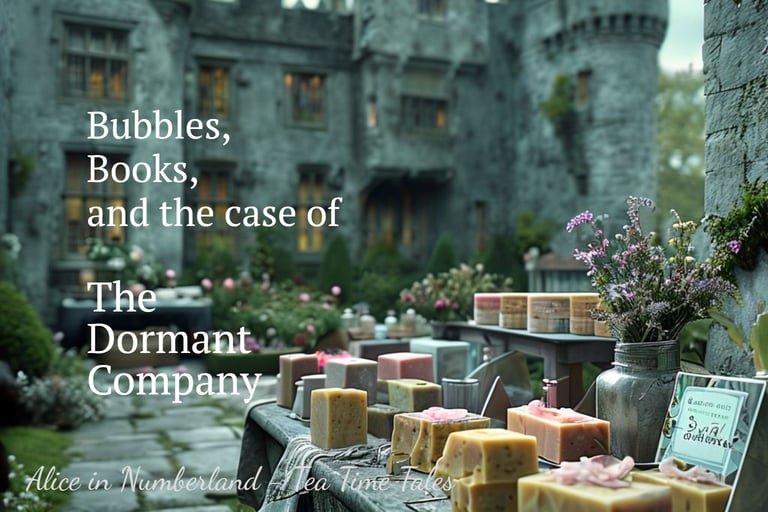

The Case of the Sudsy Seller
Gather round, grab your favourite cup, and let me tell you about a soap maker who nearly caused a mathematical mutiny in Numberland.
It all began with a bit of professional scouting. You see, when I first set up my desk at Alice in Numberland, I did what any curious bookkeeper would do: I went hunting for local Ltd companies to see who might need a bit of navigational help. I wasn't looking for a Cheshire Cat; I was looking for a market to serve. That’s when I stumbled upon a trail of bubbles leading straight to The Sudsy Seller.
On paper, this business was as still as a Dormouse in a teapot. Incorporated back in 2016, she had filed dormant accounts every single year since—citing Section 480 of the Companies Act 2006 to say she was fast asleep. Nine years of quiet. For nearly a decade, the official record told the Queen of Late Fees: "Nothing to see here, move along".
But as I sipped my tea and looked through my Samsung S25, I noticed something peculiar. The air didn't smell like dusty archives; it smelled like Lavender and Lemon Verbena. I took a peek behind the digital curtain and found a world that was anything but dormant: thousands of sales humming along on Etsy like a chorus of singing flowers and a bustling Facebook page overflowing with happy customers.
How can a company be "sleeping" on paper but throwing a full-blown garden party in the wild? My professional scepticism kicked in, and I started asking the questions that make my tea go cold: Is she trading through the Ltd company and filing the wrong accounts? Or is she a Sole Trader, with the Ltd company sitting on the shelf like a spare teabag? If she's trading personally but has a Ltd registered, is she accidentally exposing herself to the very risks she tried to avoid?
Then there’s the HMRC Dimension—the part of the map where the ink starts to smudge. You see, Companies House and the Revenue don't always speak the same language. A company might look dormant to the Registrar, but HMRC has its own rules about "non-trading." I couldn't help but wonder: has she told the Taxman she’s on pause, or is there a compliance gap wide enough for a Cheshire Cat to grin through?
After more digging than I’d care to admit, I found the most likely ending to this quest. She likely incorporated "just in case" but has been trading as a sole trader ever since. The Ltd company sits there, dormant and waiting for a party that hasn't started yet. Legally, it’s fine, as long as the bubbles don't cross and her tax footprint is in the right place. But practically? It’s an open door that keeps bookkeepers awake at night.
As for my lead list? The Sudsy Seller became a C-Grade lead. Based on her perceived turnover, she’s likely handling her own books just fine for now and doesn't quite need a professional "Alice" to take the reins. She isn't ready for me yet, but she taught me the best lesson of all: numbers tell stories, but the best tales are the ones you have to read between the lines to find.
Tip from Numberland: Compliance means satisfying both the Registrar and the Revenue—and they don’t always share a teapot! If your business is telling one story to the taxman and another to your customers, make sure your paperwork matches your reality. Even the most wonderful soap can’t wash away a messy ledger!
Another mystery managed, one bubble at a time.
Written by Alice in Numberland, friendly bookkeeping services for the curious, the cluttered, and the creative. 📍
Serving East Cleveland and beyond, or online wherever you sell your handmade knitted hares or vintage teacups.
Alice in Numberland
Professional bookkeeping solutions for your business needs.
Contact:
Tel UK (or text):
01287 750999
© 2025. All rights reserved.